
Lion’s mane (Hericium erinaceus) appears in more supplement stacks every year — and yet most people who try it report little to nothing. That gap between expectation and outcome rarely comes down to the mushroom itself. It almost always comes down to the product: under-dosed, unstandardised, or missing the extraction step that makes the bioactive compounds available at all.
The research on lion’s mane is genuinely interesting. But to understand what it found — and why your last bottle may have done nothing — you need to understand how the evidence was actually gathered, and what it requires.
What Lion’s Mane Is and What Researchers Are Looking At
Hericium erinaceus is a culinary and medicinal mushroom native to Asia, Europe, and North America. In traditional Chinese and Japanese medicine it has been used for centuries as a tonic for the nervous and digestive systems. Modern research has focused on two families of bioactive compounds unique to this species: hericenones (found in the fruiting body) and erinacines (found in the mycelium). Both have been studied for their capacity to stimulate the synthesis of nerve growth factor (NGF), a protein involved in the growth and maintenance of neurons.
NGF itself does not cross the blood-brain barrier in supplemental form — but hericenones and erinacines are small enough molecules that they can. This is what makes lion’s mane mechanistically plausible as a cognitive support ingredient, and why it is taken seriously in neuroscience literature when the quality of raw material is controlled. A review of the neurotrophic properties of Hericium erinaceus bioactives outlines this mechanism in detail (Lai et al., 2013 — International Journal of Medicinal Mushrooms).
What Human Trials Have Found
The most widely cited clinical study is a 2009 double-blind, placebo-controlled trial published in Phytotherapy Research. Researchers gave adults aged 50–80 with mild cognitive impairment either 3g/day of lion’s mane powder or placebo for 16 weeks. The supplemented group showed significantly higher scores on a cognitive function scale at weeks 8, 12, and 16; scores declined again after supplementation ended, suggesting a dependency on continued use (Mori et al., 2009 — Phytotherapy Research).
A 2023 double-blind pilot study in Nutrients examined a younger adult population (average age ~26) and found improvements in cognitive performance (Stroop test scores) and reduced subjective stress in the lion’s mane group after 28 days compared to placebo (Docherty et al., 2023 — Nutrients). This extends the observable effects beyond elderly or cognitively impaired populations.
The human trial pool remains modest — these are small studies that warrant replication at scale. What they establish is a consistent direction of effect, a coherent mechanism, and a reasonable safety profile at doses in the 1–3g/day range of standardised extract. No mainstream regulatory body has issued a formal health claim; the evidence supports continued investigation.
Why Most Lion’s Mane Supplements Don’t Produce Results
Three compounding problems explain why the category’s reputation lags the research.
1. Mycelium-on-grain products. Many products on the market use mycelium grown on grain substrates. The resulting capsule contains a significant proportion of grain starch alongside — or in place of — the mushroom biomass. Fruiting body extracts carry higher and more consistent concentrations of hericenones and beta-glucans, the compounds studied in trials. Most labels do not clearly distinguish between the two.
2. No standardisation disclosure. Beta-glucans are the standard proxy marker for mushroom raw material quality. A product standardised to 30–50% beta-glucans from fruiting body is making a meaningful quality commitment. A label listing only “500mg lion’s mane” with no standardisation figure is not. Analysis of commercially available mushroom supplements has repeatedly found wide divergence between label claims and actual bioactive content.
3. Inconsistent, short-term use. The Mori trial ran for 16 weeks, and the cognitive score gains reversed after supplementation ended. This is not a fast-acting stimulant — it requires consistent daily use at an appropriate dose. Taking it sporadically for two weeks will not reproduce what the trials measured.
How We Approached It in Yerba Brew
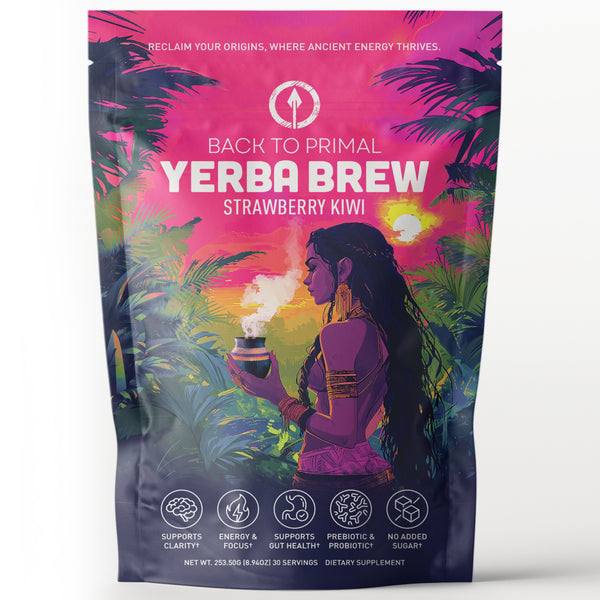
When formulating Yerba Brew — our morning ritual powder — we included 500mg of lion’s mane extract standardised to 50% beta-glucans. The standardisation figure is on the label. The formula pairs this with 2000mg of yerba mate extract for clean, sustained energy and 1000mg of inulin (chicory root fibre) as a prebiotic — supporting focus and the gut-brain axis simultaneously, without overstating any compound’s individual contribution.
The logic: if you are going to take lion’s mane daily, pair it with an ingredient that gives you an immediate, tangible reason to reach for the same product every morning. Consistency is the active ingredient. The yerba mate provides the signal; the lion’s mane works quietly in the background across weeks.
What to Check Before You Buy
- Is the source fruiting body, or mycelium-on-grain? The label should say.
- Is it standardised to a defined percentage of beta-glucans?
- Is the dose at least 500mg of extract — ideally 1–3g/day for consistent use?
- Are you taking it every day? Trial evidence is built on daily supplementation across weeks to months.
Sources & Further Reading
- Mori K, Inatomi S, Ouchi K, Azumi Y, Tuchida T (2009). Improving effects of the mushroom Yamabushitake (Hericium erinaceus) on mild cognitive impairment: a double-blind placebo-controlled clinical trial. Phytotherapy Research. doi:10.1002/ptr.2634
- Docherty S, Doughty FL, Smith EF (2023). The Acute and Chronic Effects of Lion’s Mane Mushroom Supplementation on Cognitive Function, Stress and Mood in Young Adults. Nutrients. doi:10.3390/nu15224842
- Lai PL, Naidu M, Sabaratnam V, et al. (2013). Neurotrophic properties of the Lion’s mane medicinal mushroom, Hericium erinaceus (Higher Basidiomycetes) from Malaysia. International Journal of Medicinal Mushrooms. doi:10.1615/IntJMedMushrooms.2013005225
- Ma BJ, Shen JW, Yu HY, Ruan Y, Wu TT, Zhao X (2010). Hericenones and erinacines: stimulators of nerve growth factor (NGF) biosynthesis in Hericium erinaceus. Mycology. doi:10.1080/21501201003735556
This article is for educational purposes only and does not constitute medical advice. Consult a qualified healthcare professional before changing your supplement routine, particularly if you have a pre-existing health condition or take medication.
0 comments